



Yahoo TW Ecommerce, a leading ecommerce company in Taiwan operating as a strategic joint venture with a market-leading local retail conglomerate, reduced the time required for sellers to complete a product listing on its platform, Yahoo Auction, from twenty minutes to just two. By integrating privacy-first, on-device built-in AI primitives to power an automated listing assistant and hyper-personalized user experiences, the platform achieved a 3% click-through rate (CTR).
This integration benefits both sides of the marketplace: shoppers get useful, context-aware personalized features that simplify discovery, while the business sees higher engagement compared to legacy backend algorithms. Ultimately, this on-device architecture lowers the operational burden for sellers while safeguarding sensitive user data locally and insulating the company and its customers from compounding cloud scaling costs.
Why Yahoo TW Ecommerce chose built-in AI
Yahoo TW Ecommerce's decision to adopt on-device, built-in AI stems from two primary business requirements:
- Data privacy: By utilizing the user's first-party, on-site interaction history and authenticated session data and running models locally, sensitive user information never leaves the device.
- Cost effectiveness democratization: Cloud-hosted AI infrastructure costs scale directly with user traffic, frequently forcing digital platforms to gate advanced tools and personalized experiences behind premium subscriptions or increased merchant transaction fees. Shifting inference on-device eliminates this compounding backend operational overhead. This sustainable architecture allows Yahoo TW Ecommerce to democratize highly responsive, personalized capabilities for all sellers and shoppers across the marketplace, free of premium paywalls or passed-down ecosystem fees.
The benefits of built-in AI are especially impactful for the Yahoo Auction case as it enables ambient intelligence, meaning helpful, context-aware assistance that is locally processed and delivered right when the user needs it. Because the browser processes data client-side, it securely offers these smart aids without sending sensitive interaction logs to external servers.
Nine ways built-in AI powers Yahoo Auction
Yahoo TW Ecommerce implemented nine distinct use cases using built-in AI, spanning across ambient intelligence, content management, and shopping support:
Content creation and management
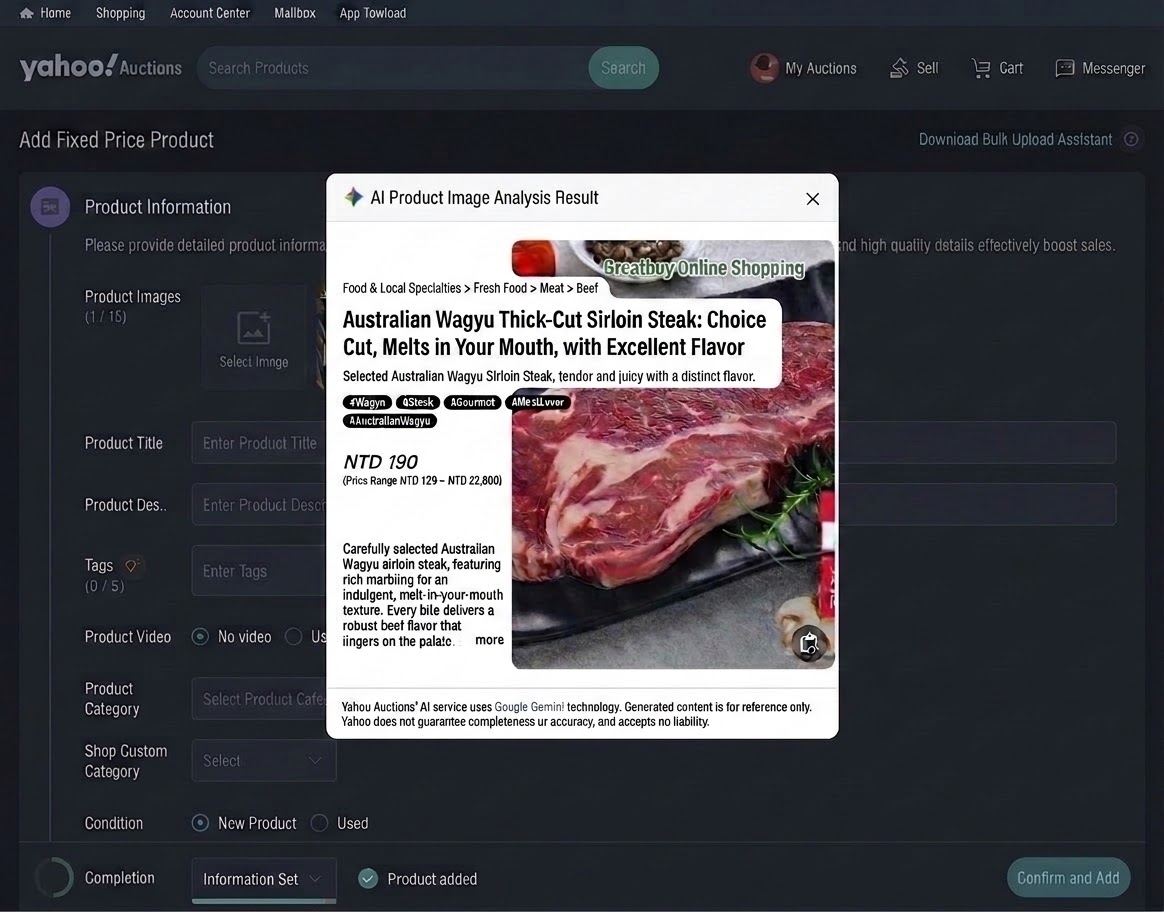
Listing assistant for sellers: Helps sellers quickly generate engaging and accurate product descriptions. By uploading a single product picture, Yahoo Auction's AI-powered assistant suggests a relevant product category, draft title, details, hashtags, and suggested price within 20 seconds for sellers to review. The draft serves as a helpful baseline for the sellers, reducing the average time to fill out a listing from 20 minutes to 2 minutes.
The following images have AI-translated text.

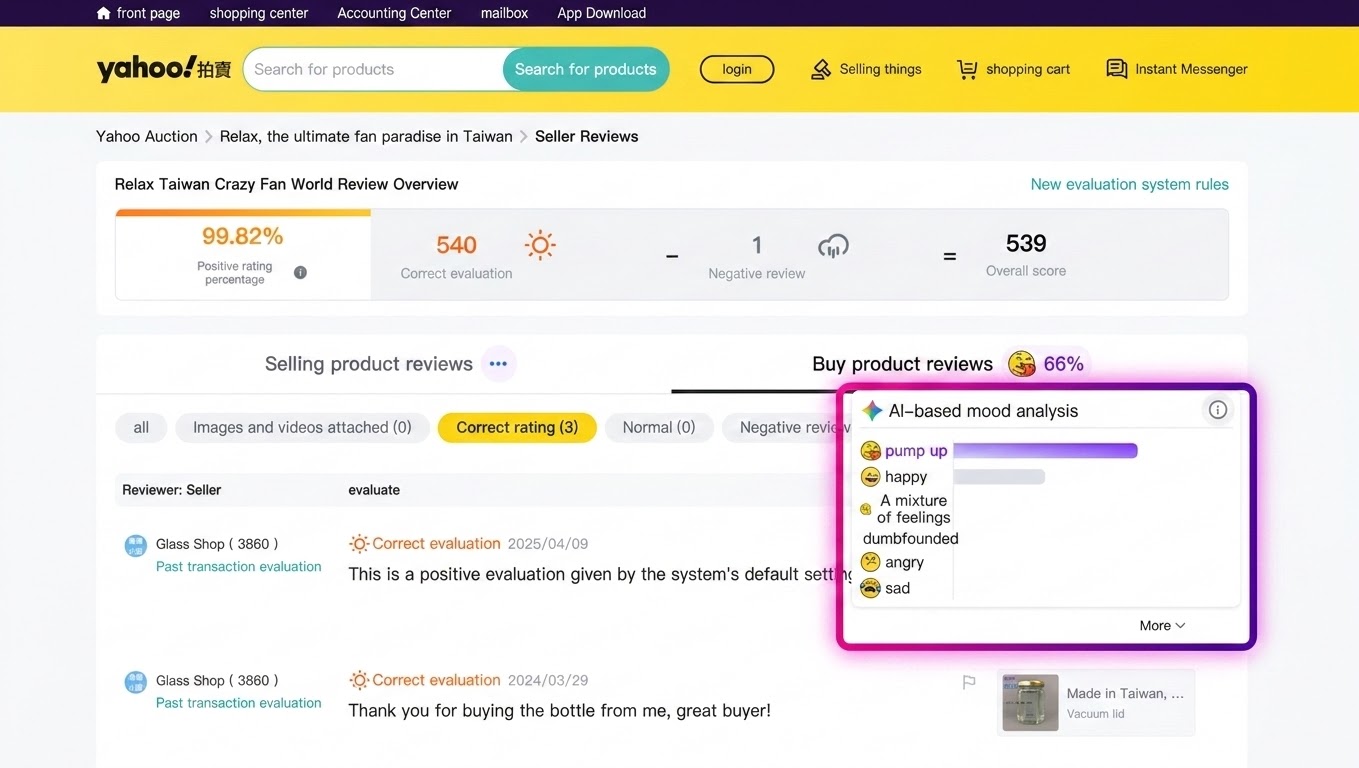
Review assistant for buyers: Helps buyers with highly contextual, well-written expression suggestions to better structure and describe their experience based on the user's selected rating and sentiment input.
Ambient intelligence
In this context, ambient intelligence refers to proactive, context-aware assistance that fits naturally into the user's browsing experience.
Here's how Yahoo TW Ecommerce implemented ambient intelligence for its users:
Personalized product recommendations carousel: Analyzes a logged-in user's recent purchase history to recommend high-affinity products that complement their purchases, boosting conversion rates.
Predictive search and recommendations: Tailors product recommendations and search keywords to the logged-in user based on the user's active session. By referencing local context, such as the user's recent on-site searches and site-specific browsing preferences, the client-side processing predicts and suggests helpful search keywords to simplify the discovery process of the customer journey.
Shopping support
Product summarization: Summarizes lengthy product detail pages into easily digestible highlights in less than 100 words.
Emoji-based review summarization: Aggregates customer feedback into a concise overview utilizing representative emoji.
Loyalty point utilization: Identifies a logged-in user's loyalty points and suggests items purchasable with expiring points (or minimal additional payments) and then leverages local inference to rank and select the best matches based on the user's personalized interests.
Lifestyle recommendations: Offers personalized styling inspirations or home decor advice based on the product category the user is viewing.
Shopping assistant chatbot: Provides an interactive, on-device chatbot to answer buyer queries instantly using natural language text or voice input. The on-device model analyzes the conversation for purchase intent, intelligently deducing and curating product lists that align with the user's interests.
Real-world business impact
Since deploying these features live to production at the end of 2025, Yahoo TW Ecommerce has tracked significant engagement milestones using Google Analytics:
- Significant efficiency gains: The listing assistant for sellers helped reduce the average time required to complete a product listing by 90%, from 20 minutes to just 2 minutes.
- Deep engagement: The platform generated over 1 million total interaction events across more than 100,000 unique users. This highlights high user interest and adoption, confirming that users are actively exploring and utilizing the new AI tools.
- High-quality interactions: The new "ambient intelligence" modules achieved a click-through rate (CTR) of nearly 3% compared to a 1.3 to 1.8% CTR on the legacy product recommendations that rely on standard algorithms or manual curation by the editorial team. Because the AI-driven recommendations drop directly into the website's existing standard carousel layout, the team avoided costly frontend refactoring. This seamless implementation minimizes engineering overhead, while the direct performance comparison proves that the underlying on-device AI surfaces highly relevant, high-converting suggestions.
A closer look at ambient intelligence
Among the nine use cases, the implementation of ambient intelligence stands out as a prime example of what makes on-device AI uniquely powerful. Yahoo Auction's ambient intelligence modules streamline the user journey. They act as helpful, on-device assistants providing real-time, context-aware suggestions exactly when they are most helpful to the user.
Secure data and reduce cloud costs with a local architecture
Generating this level of hyper-personalized recommendations requires analyzing highly sensitive user data. Yahoo Auction utilizes a user's rich contextual data like purchase history, search keywords, and browsing preferences from local storage. Sending this volume of personal data to a cloud server introduces huge latency and significant privacy risks.
Yahoo TW Ecommerce solved this by relying on local architecture. By utilizing session data and local storage, the local AI model processes everything client-side. This ensures that no personal data is exposed externally, proving that deeply personalized, proactive intelligence is uniquely suited for local AI.
"Built-in AI empowers us to deliver hyper-personalized, ambient experiences without compromising our users' privacy or introducing hidden fees or paywalls to our community. It's a paradigm shift in how we approach ecommerce intelligence."
— Paul Li, Lead Engineer, Yahoo TW Ecommerce
Manage the built-in AI lifecycle
Integrating built-in AI into a production environment requires managing model download states gracefully. Because the built-in AI specifications and download behaviors can change, the Yahoo TW Ecommerce team built a dedicated Web Component to streamline maintenance.



This wrapper component provides standard, decoupled properties and handles the
complete user download lifecycle. By observing the component's data-status
attribute, the team dynamically updates the user interface to reflect the
model's exact state: Unavailable, downloadable, downloading,
available.
This design allows the platform to maintain UI stability and provide updates instantly across pages without refactoring underlying core code.
Overcome MPA constraints with SharedWorker orchestration
In Multi-Page Applications (MPAs), developers typically use background threads to maintain long-running workflows that survive same-site navigations. While built-in AI APIs are natively asynchronous and don't negatively impact the main thread's UI responsiveness, moving them to a background thread prevents active inference sessions from being abruptly terminated when a user navigates between pages.
However, built-in AI primitives like the Prompt API are restricted to top-level document contexts. This is due to an open web platform specification challenge: the W3C Permissions Policy framework is fundamentally tied to the document tree, and standard mechanisms to propagate these security boundaries down to independent worker roots are still being designed by the community.
The solution: SharedWorker as a Resource Orchestrator
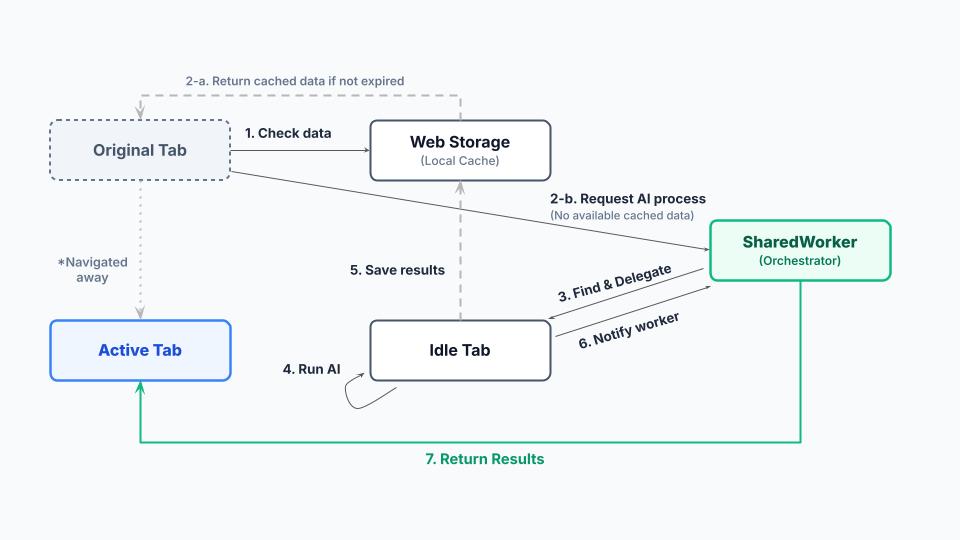
To safely navigate these lifecycle constraints while respecting document-bound security boundaries, Yahoo TW Ecommerce used a SharedWorker to coordinate AI computing across same-origin browser tabs. Instead of letting a page navigation cancel an active AI computation, the SharedWorker acts as a centralized event broker. When an on-device AI computation is requested, the SharedWorker coordinates across the origin's concurrent open tabs, delegating the execution to a parallel tab context that is less prone to active navigation and processes the prompt to completion without premature interruption. Once the AI computation ends, the result is securely cached in Web Storage with a designated time to live (TTL), making it instantly accessible across any of the website's open tabs. This design ensures that on-device AI operations are resilient against page transitions, maximizing efficiency and consistency across the entire Multi-Page Application journey.
You can find details of these architectural workarounds from GitHub:
These features are live in Yahoo拍賣.
The future of client-side AI
Yahoo TW Ecommerce's implementation of built-in AI demonstrates the practical value of on-device models. By prioritizing cost-effectiveness and strict data privacy, they unlock powerful ambient intelligence features that safely utilize local browser credentials and rich user history.
As we continue to evolve, the lessons learned from Yahoo TW Ecommerce's architecture serve as a foundational blueprint for other developers looking to build secure, locally-driven AI experiences on the web.