

Published: September 22, 2026
Chrome 153 and Chrome 154 rolled out to stable over the past month, delivering a wave of developer improvements ready for your everyday workflow. This edition highlights fine-grained JavaScript execution controls in DevTools for agents, ad script tracking in the Application panel, full soft navigation support and CPU performance tier overrides in Performance, support for inactive styles and keyboard-accessible adorners in Elements, source inspection and performance trace recording in AI assistance, and modernized device presets in Device Mode.
DevTools for agents
The Chrome DevTools MCP server introduces new security controls, performance tuning, and memory analysis capabilities for coding agents:
- Agent Plugins 1.0 package: Added support for the Agent Plugins 1.0 package, allowing agents to load and execute modular plugin extensions.
- JavaScript execution controls: Configure
--no-javascript-evaluationor turn off JavaScript execution tools to inspect pages without evaluating scripts, extending across navigations and initialization scripts. - On-demand source maps: Added an option to disable source maps and lazy-load source maps on demand, preventing high memory usage on large sites.
- Configurable file system roots and CLI path permissions: The CLI now
includes
--allow-unrestricted-pathsby default and supports configurable file system roots. - Heap snapshot inspection: Query objects directly by retained size or
property name with
query_heapsnapshot, view self and retained sizes for edges, and inspect memory retained by V8 execution contexts. - PWA automation tools: Added dedicated tools for automating Progressive Web App installation and lifecycle checks.
- Console stack traces: Retrieve optional stack traces when listing
console messages with
list_console_messages.
Learn more in the chrome-devtools-mcp repository.
Application: Ad script tracking in the Ads section, and cookie flag editing
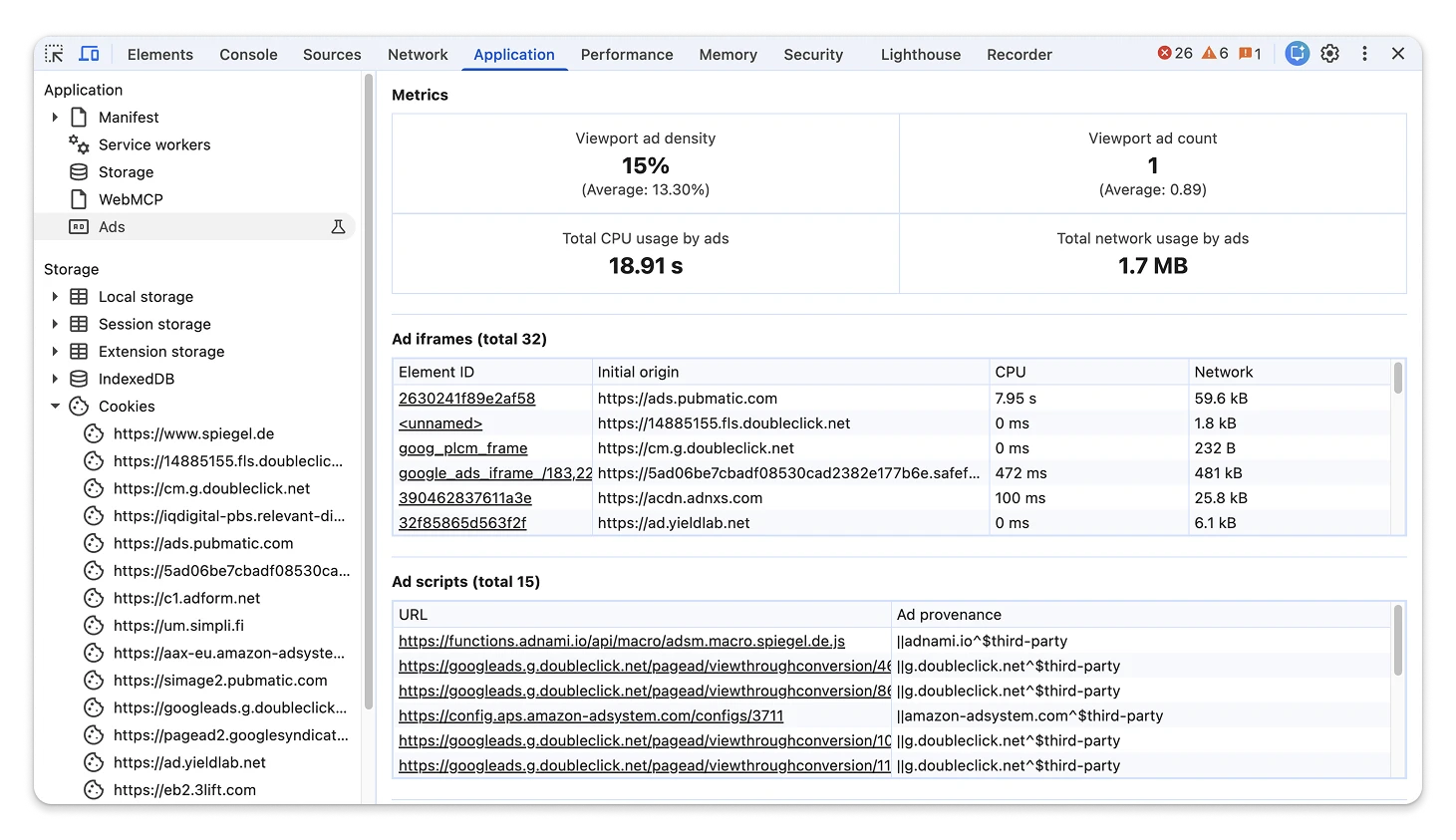
Following the introduction of four experimental ad metrics for the Chrome User Experience Report (CrUX), this new sub-panel is a centralized location to debug and optimize page-wide ad-related information. This includes:
- A dashboard for the new experimental metrics: Viewport ad density, Viewport ad count, Total CPU usage by ads, Total network usage by ads.
- Segmentation of CPU and network usage by ads elements
- A table of ads scripts in the main frame.
- A toggle that highlights ads on the page.
Learn more about the new ad metrics in our documentation.
Chromium issues: 514957134, 512927903, 540469610
Performance: Full soft navigation support, CPU performance tier overrides, and extension track search
The Performance panel offers end-to-end soft navigation measurement, hardware calibration overrides, and deeper trace search:
- Full soft navigation support: Following the introduction of soft navigation support in Live Metrics and trace views in Chrome 152, soft navigation analysis is now available in Insights, completing full end-to-end support for measuring soft navigations in the Performance panel.
- CPU performance tier override over CDP: DevTools now supports
configuring, calculating, and dispatching calibrated CPU performance tier
overrides over Chrome DevTools Protocol
(
Emulation.setCPUPerformanceOverride), enabling reproducible performance testing across hardware tiers. - Extension track search in flame chart: Pressing
Ctrl+Fin the Performance panel flame chart now matches entries in custom tracks registered using the Extensibility API, searching their tooltip text, properties, and user details. - CPU profile thread visualization: The Performance panel flame chart now renders threads that contain only CPU profile samples, ensuring background executions such as WebAssembly threads appear in timeline views.
Chromium issues: 449760252, 483092899, 540020488
Elements: Inactive styles, keyboard-accessible adorners, and tree outline fixes
Inspecting and authoring CSS is faster and more accessible in the Elements panel:
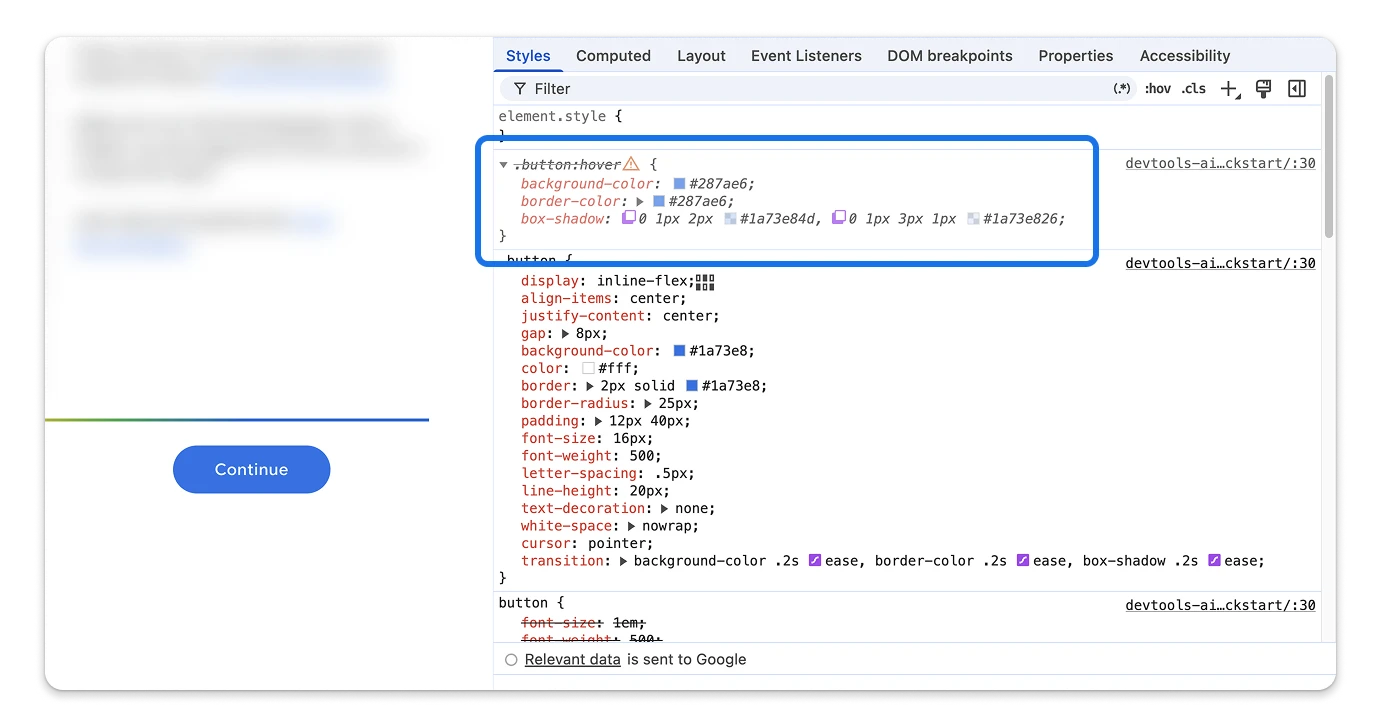
- Inactive styles support: DevTools can now continue showing style rules that previously matched the selected element when they no longer apply, clearly distinguishing them with an inactive visual indicator. Enable inactive styles and configure their collapsing behavior in Settings.
- Keyboard-accessible adorners: Interactive adorners in the DOM
tree—including View Source, Starting Style, Scroll Snap, and
Reveal—are now keyboard focusable and can be activated using
EnterorSpace. - Drag-and-drop reordering: Reordering DOM nodes by dragging elements in the DOM tree now functions reliably across shadow DOM boundaries, with clear drop placement indicators.
- Smoother CSS property toggling: Toggling CSS property checkboxes in the Styles tab no longer triggers duplicate UI repaints or visual flashing.
Chromium issues: 539424116, 554057179, 555088527, 548477554
Device Mode: Modernized device presets grouped by form factor
The Device Mode toolbar and Settings > Devices view organize emulated hardware into clear categories:
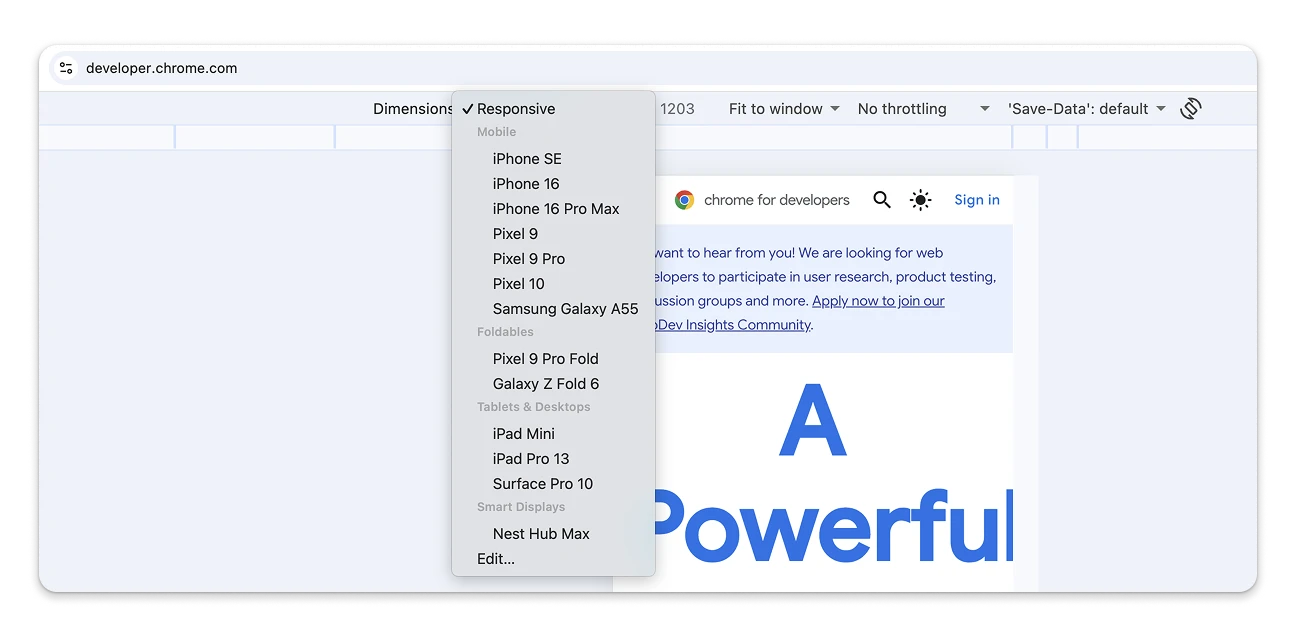
- Form factor grouping: Emulated devices are now grouped into Mobile, Foldables, Tablets & Desktops, and Smart Displays.
- Updated hardware catalog: Added modern presets—including iPhone 16, Pixel 9, Pixel 10, Galaxy Z Fold 6, iPad Pro 13", and Nest Hub Max—while retiring outdated legacy device definitions.
Chromium issues: 526856234, 526857820
Network: Edit and resend as fetch in Console, and local overrides security
Network request inspection and debugging workflows have been streamlined and secured:
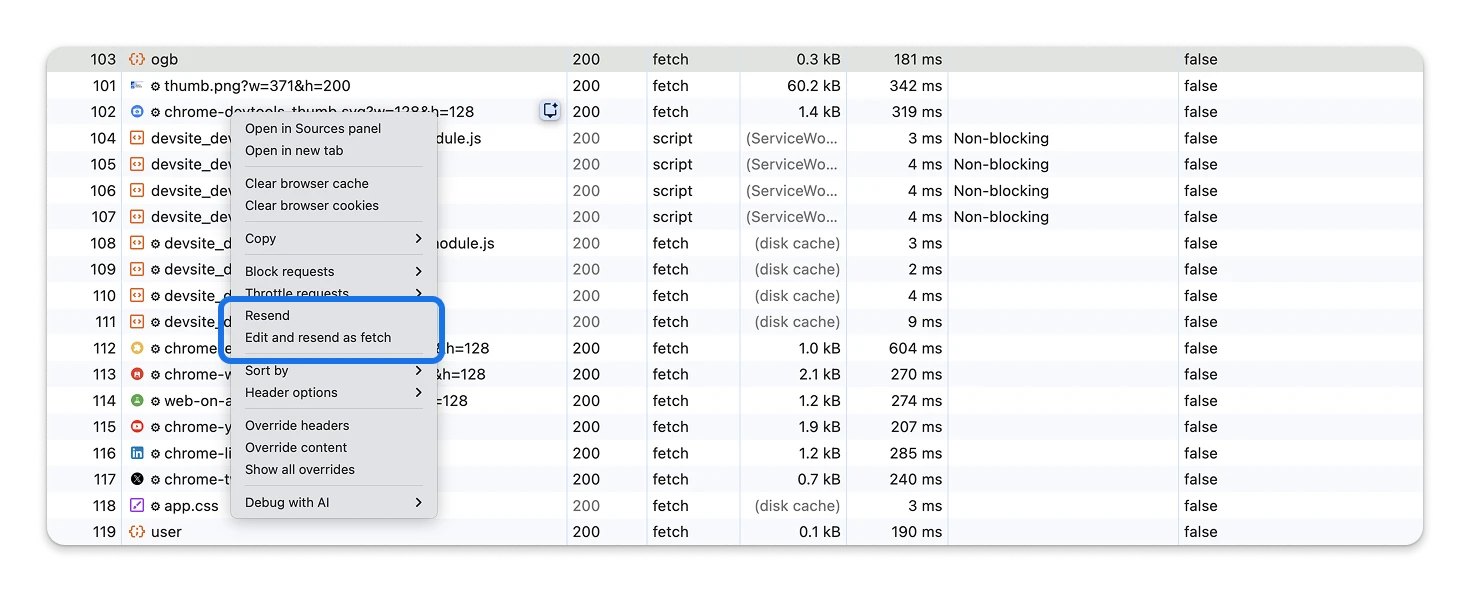
- Edit and resend as fetch in Console: Selecting Edit and resend as
fetch on any network request now automatically focuses the Console
panel with the
fetch()expression already pasted into the prompt, complete with parameter comments and a reference link to the original request. - Local overrides security hardening: The Network panel now prevents
path traversal (
%2E%2E) in local overrides and prohibits creating overrides on non-http(s) schemes likedata:,blob:,javascript:, andabout:. - Caret escaping in Copy as curl (cmd): Copying network requests as curl
commands for Windows
cmd.exenow caret-escapes parentheses and backticks, preventing command syntax errors when pasted into alternative shells. - Binary payload cursor synchronization: The Payload tab maintains your scroll and cursor position when switching between Hex, Base64, and UTF-8 views.
Chromium issues: 40726969, 513843792, 513836026, 407750982
Memory: Heap snapshot edge filtering, size sorting, and object querying
The Memory panel provides more granular tools for analyzing heap snapshots:
- Edge sorting and filtering: You can now filter edges in heap snapshots
by a minimum retained size and filter out primitive values (
null,undefined,true,false) to focus on meaningful object references. Edges can be sorted by retained size, self size, or name. - Direct object querying: DevTools supports querying heap snapshot objects directly by retained size threshold or property name, streamlining memory leak investigations.
- Context retention analysis: Heap snapshots can calculate and report the aggregate memory kept alive specifically by V8 execution contexts.
- Resilient snapshot parsing: Invalid or corrupted heap snapshot files now surface clear errors rather than causing parsing hangs.
Chromium issues: 497855658
Accessibility improvements
Chrome 153 and Chrome 154 include the following accessibility enhancements:
- Elements: VoiceOver on macOS now announces "expanded" and "collapsed" state changes through a polite live region when navigating DOM tree items. (Chromium issue: 540028208)
- Issues: Resolved duplicate screen reader announcements in the Issues counter, reading a single clean summary and applying correct non-button semantics within the Issues panel. (Chromium issue: 536977880)
- Elements: Interactive adorners (View Source, Starting Style, Scroll Snap, and Reveal) are fully focusable and activatable using the keyboard. (Chromium issue: 554057179)
- Live regions: Added the
AccessibilityAnnouncementRecordingViewto record and debug live announcements andariaNotifycalls. (Chromium issue: 527462118)